Bitcoin Was Supposed to Be Digital Gold. After a War and a Dollar Crisis, Has It Proven That Claim — or Failed It?
How to think about Bitcoin, gold, and “safe havens” after the most turbulent six months in a decade


The Pitch and the Test
For more than a decade, Bitcoin’s most passionate advocates have repeated a single, elegant thesis: Bitcoin is digital gold. Finite supply, no central issuer, immune to the printing press. If you believed the pitch, the last eighteen months should have been the proving ground — a real war, surging inflation, a wobbly dollar, and central banks hoarding metal at a pace not seen in half a century. Gold got the script and played its part. Bitcoin, characteristically, improvised.
On January 28, 2026, gold touched an all‑time high of $5,589 per ounce, capping a run that had taken the metal from roughly $2,624 at the start of 2025 to $4,340 by year‑end — a gain of approximately 65%, the strongest calendar‑year performance since 1979. Bitcoin, meanwhile, had peaked months earlier at above $126,000 in October 2025, then drifted lower, closing the year near $88,430 for a modest loss of about 6%.
Then came the real stress test.
The Scoreboard Through the Storm
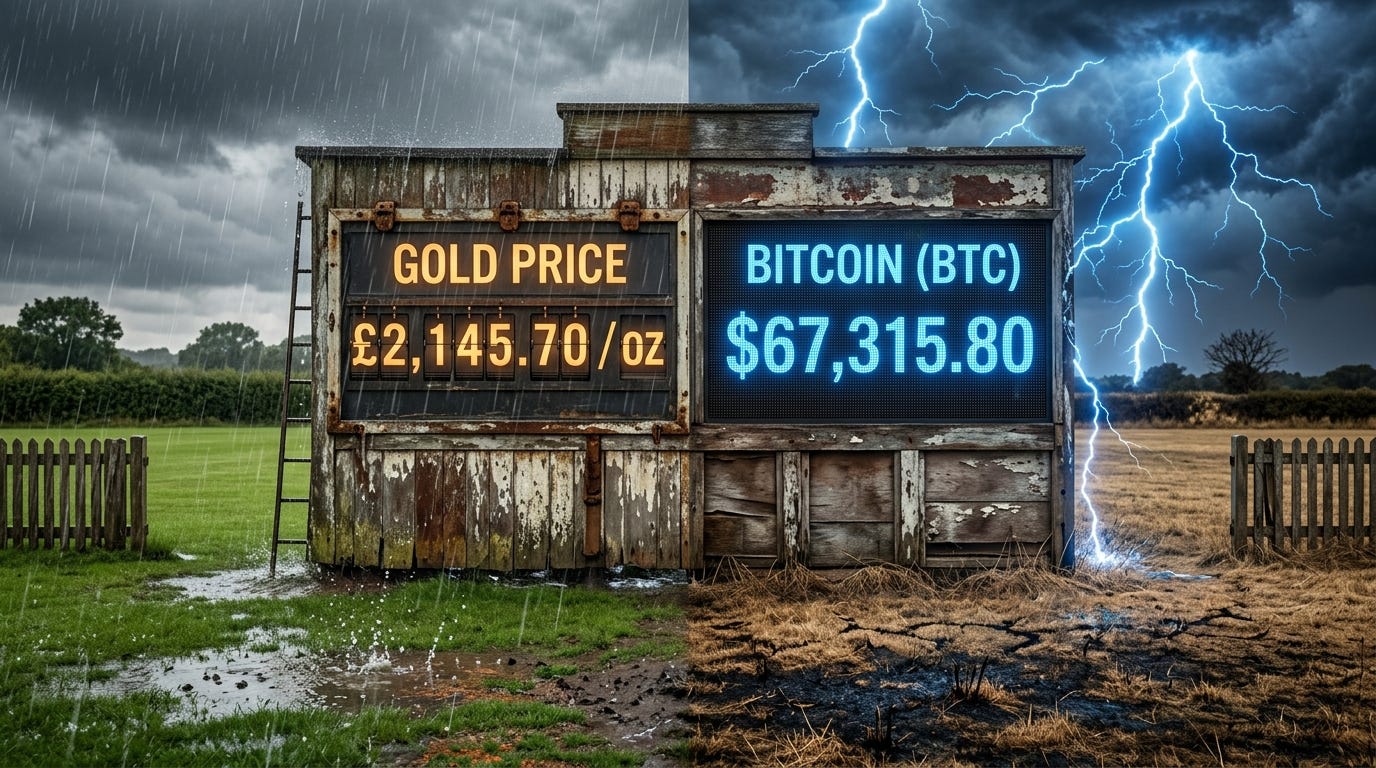
Before diving into what the numbers mean, it helps to see them side by side.
Gold’s journey. The metal opened 2025 at $2,624 per ounce and finished the year near $4,340, a gain of roughly 65%. In January 2026 it surged again, touching $5,589 on the 28th. The rally stalled, then reversed hard: by March 24 gold had plunged to an intraday low of $4,098 — a peak‑to‑trough drawdown of roughly 27%. It has since recovered to around $4,693 as of the date of publication, which puts it approximately 79% above where it stood at the start of 2025 and about 16% below the January peak. For calendar year 2024, gold returned approximately 26–27%.
Bitcoin’s journey. Bitcoin began 2025 near $94,000, fresh off a spectacular 121% gain in 2024. It climbed to an all‑time high above $126,000 in early October 2025, then faded, ending the year at roughly $88,430 — a calendar‑year loss of about 6%. It opened 2026 near $87,500, briefly touched $98,000 in mid‑January, and then fell off a cliff: by February 5 it had crashed to approximately $60,000, the steepest drawdown since the FTX implosion in late 2022. From there it ground higher, hitting roughly $81,000 in April and sitting near $81,000 today — about 8% below where it started the year and roughly 14% below its level at the start of 2025. It remains 36% below its all‑time high.
The Bitcoin‑to‑gold ratio tells the story in a single number. In December 2024, one Bitcoin bought roughly 40 ounces of gold — a record. Today it buys about 17. That is a 57% collapse in Bitcoin’s purchasing power measured in the asset it claims to rival.
The War Test

On February 28, 2026, the United States and Israel launched joint military strikes against Iran. Within hours, Brent crude spiked above $110 per barrel — up more than 55% from the roughly $72 level that had prevailed just weeks before. U.S. consumer inflation, already elevated, would climb to 3.3% year‑over‑year by the March print, the highest reading since May 2024. The Federal Reserve held its benchmark rate at 3.50–3.75%, trapped between a slowing economy and resurgent price pressures.
Gold’s immediate reaction was volatile but ultimately supportive. After an initial wave of liquidation — leveraged traders dumping everything for cash — the metal found its footing and began grinding higher. Central banks, led by the People’s Bank of China on a 17‑consecutive‑month buying streak, continued accumulating. J.P. Morgan projects central banks will purchase roughly 755 tonnes of gold in 2026, only modestly below the torrid pace of recent years. Gold ETFs did see outflows — roughly $8–11 billion over the most chaotic three‑week stretch — but that selling was dwarfed by sovereign and institutional buying underneath.
Bitcoin’s initial reaction was ugly. In the first hours of the strikes, it slid from around $66,000 to $63,000, and approximately $128 billion in crypto market capitalisation was erased. The narrative of “digital gold rushing to safety” did not materialise in real time. But here is where the story gets more nuanced than either camp wants to admit: over the following weeks, Bitcoin staged a recovery that, on a percentage basis, outpaced gold’s rebound by roughly 35–36 percentage points when measured through the Bitcoin‑to‑gold ratio. By April, Bitcoin had posted a monthly gain of approximately 12–14%, its strongest month of the year.
So did Bitcoin fail the war test? In the first hours, yes — unambiguously. It sold off like a risk asset, not a safe haven. But over the medium term, its recovery was faster and more aggressive than gold’s. The question is whether you needed your hedge to work in the first hour or the first quarter.
The Identity Crisis
The correlation data in 2026 paints a picture that Bitcoin maxis would rather not frame. During March, Bitcoin’s 30‑day correlation with the S&P 500 spiked to 0.74 — the highest of the year — according to data reported by Bloomberg, Phemex, and multiple quant desks. At the same time, its correlation with gold was approximately –0.88. And its correlation with the U.S. Dollar Index (DXY) sat near –0.90 in late April.
Read those numbers carefully. A safe‑haven asset should be positively correlated with gold and negatively correlated with equities during a crisis. Bitcoin did the opposite: it moved with stocks and against gold. It behaved, in the language of portfolio theory, like a high‑beta risk asset with a dollar‑weakness kicker — not like a store of value.
Gold’s annualised volatility typically runs in the range of 15–20%. Bitcoin’s, even in a year where it has been comparatively subdued, sits around 70–80%. In a remarkable twist, gold’s own 30‑day realised volatility briefly topped 44% in early 2026 — the highest since the 2008 financial crisis — and for a fleeting moment actually exceeded Bitcoin’s. But that anomaly was short‑lived. Over any meaningful lookback period, Bitcoin remains four to five times as volatile as gold.
None of this means Bitcoin is useless. It means it is not gold. It has never behaved like gold during an acute crisis, and the data from 2026 — the most significant geopolitical shock in years — confirms the pattern rather than breaking it.
What Bitcoin Actually Is

Strip away the mythology and look at what the data actually says Bitcoin is in 2026.
It is a scarce, globally liquid, speculative macro asset that functions as a leveraged bet against the U.S. dollar. When the DXY weakens, Bitcoin tends to strengthen — and vice versa. The dollar has fallen roughly 9–10% year‑to‑date in 2026, battered by war‑driven fiscal pressures, a federal debt pile that now exceeds $39 trillion, and a growing global appetite for alternatives to dollar‑denominated reserves. That dollar weakness has been a tailwind for Bitcoin, but not enough to overcome the risk‑off headwinds from the war itself and the broader equity drawdown.
Institutionally, Bitcoin has never been more embedded in the financial system. Spot Bitcoin ETFs now hold approximately $109 billion in assets under management across the U.S., with BlackRock’s iShares Bitcoin Trust (IBIT) commanding roughly 70% of net flows. In April 2026 alone, spot Bitcoin ETFs attracted $2.44 billion in net inflows, even as the price remained well below its highs. The U.S. government itself holds an estimated 328,000 BTC in a Strategic Bitcoin Reserve established by executive order. MicroStrategy (now Strategy) holds roughly 818,000 BTC. El Salvador’s sovereign stash sits near 7,600 BTC. More than 172 publicly traded companies now carry Bitcoin on their balance sheets.
The network’s hashrate — a proxy for the computational security underwriting the system — averaged approximately 970 EH/s in the two weeks ending May 1, with the broader 2026 average hovering near 1,000 EH/s. That is an extraordinary amount of real‑world energy and capital devoted to maintaining the ledger.
The regulatory scaffolding has also matured. The GENIUS Act, signed into law on July 18, 2025, created the first comprehensive federal framework for stablecoins in the United States. The total stablecoin market capitalisation now stands at roughly $321 billion, with Tether (USDT) at approximately $190 billion and USDC at $77 billion. Stablecoins are the plumbing through which much of the crypto economy flows, and their legitimisation has anchored Bitcoin’s institutional story even as its price has struggled.
So Bitcoin in 2026 is not digital gold. It is something that did not exist before: a decentralised, digitally native macro asset with deep institutional liquidity, regulatory recognition, and sovereign‑level holders — but with the volatility profile of a growth stock and the crisis behaviour of a risk‑on trade.
The Dollar Crack in the Foundation
Both gold and Bitcoin bulls agree on one thing: the dollar’s structural position is deteriorating. The DXY’s 9–10% decline this year is not just a war blip; it reflects deeper anxieties. U.S. federal debt has surpassed $39 trillion. The fiscal deficit is running near 7% of GDP. The Federal Reserve is holding rates at 3.50–3.75%, unable to cut meaningfully because inflation has re‑accelerated to 3.3%, yet unable to hike because the economy is already absorbing a war shock and an oil‑price surge.
Meanwhile, China’s Cross‑Border Interbank Payment System (CIPS) recorded a daily settlement record of 1.22 trillion yuan in March 2026 — a signal, however early, that alternative payment rails are gaining traction. Central banks are not just buying gold; they are, in aggregate, reducing their dependence on dollar‑denominated reserves.
Gold has been the primary beneficiary of this shift. Its role as a reserve asset is centuries old, universally understood, and does not require an internet connection or a private key. Bitcoin may benefit over the long term from the same structural dollar weakness, but it has to compete for that capital with gold, with other commodities, with foreign equities, and with the simple inertia of the existing system.
The Portfolio Question

If you own physical gold or gold‑linked assets as part of a long‑term portfolio, the last eighteen months have validated that position spectacularly. Gold is up 79% since January 2025. It absorbed a war, an inflation spike, and a dollar crisis, and it is still standing at roughly $4,693 per ounce. It did what it was supposed to do.
If you own Bitcoin, the picture is more complicated. You are down 14% from where you stood at the start of 2025 and down 8% year‑to‑date. You are sitting on a 36% drawdown from the all‑time high. But you are also holding an asset that has recovered from $60,000 to $81,000 in three months, that posted a 12% monthly gain in April, and that is backed by deeper institutional infrastructure than at any point in its history.
The honest answer to the question posed in the headline — has Bitcoin proven the digital‑gold claim or failed it? — is neither, because the claim itself was always a category error.
Gold is an anchor. It is the asset you own for the worst hour of the worst day. It has thousands of years of behavioural conditioning behind it. When bombs fall, humans reach for gold — not because of a whitepaper, but because of something closer to instinct.
Bitcoin is a satellite. It is the asset you own for the medium‑term structural decay of fiat currency systems. It offers asymmetric upside in environments where the dollar weakens, liquidity expands, and institutions continue to adopt. But it does not protect you at 2 a.m. when the first missiles launch. It sells off with everything else in the first wave of panic, and then it recovers — often violently — once the dust settles.
The Bitcoin‑to‑gold ratio, now at roughly 17 ounces per Bitcoin versus 40 at the peak, is a real‑time measure of which narrative the market believes today. Gold is winning. But “today” is not “forever,” and the ratio has swung wildly in both directions over the past five years.
The Verdict

Bitcoin did not prove it was digital gold in 2026. It proved it was something else — something valuable, but different. It is a speculative store of energy, a bet on the continued erosion of the dollar‑centric financial order, and an increasingly institutionalised alternative asset. It failed the crisis‑hour test and passed the crisis‑quarter test. Whether that is good enough depends entirely on your time horizon and your definition of “safe.”
Gold, for its part, did exactly what gold always does. It absorbed fear, stored value, and asked nothing of its holders except patience. It did not need a network, a wallet, or an exchange. It just sat there, being gold, and it was up 79% for its trouble.
For most long‑term investors, the answer is probably not “either/or” but “both, in different doses and for different reasons.” Gold as the foundation; Bitcoin as the speculative wing. The ancient hedge and the digital experiment, held together by the same underlying conviction: that the institutions printing the money cannot be trusted to preserve its value.
That conviction, at least, both assets share.
Key Data at a Glance — May 13, 2026
Metric Value Gold (spot) $4,693 /oz Gold YTD 2026 +7 % Gold since Jan 1, 2025 +79 % Gold ATH $5,589 (28 Jan 2026) Bitcoin (spot) ~$81,000 Bitcoin YTD 2026 –8 % Bitcoin since Jan 1, 2025 –14 % Bitcoin ATH >$126,000 (Oct 2025) BTC / Gold ratio ~17.3 oz / BTC Spot BTC ETF AUM ~$109 B Spot BTC ETF inflows (Apr 2026) $2.44 B Strategy (MSTR) BTC holdings ~818,000 BTC US Strategic Bitcoin Reserve ~328,000 BTC BTC 30‑day vol (annualised) ~70–80 % Gold 30‑day vol (annualised) ~15–20 % Fed funds rate 3.50–3.75 % US CPI (Mar 2026, YoY) 3.3 % Brent crude ~$110 /bbl DXY (YTD change) –9 to –10 % US federal debt >$39 T Stablecoin market cap ~$321 B BTC network hashrate ~970 EH/s Central‑bank gold purchases (2026 est.) ~755 tonnes
Sources: Yahoo Finance, CNBC, Reuters, Bloomberg, Kitco, CoinDesk, J.P. Morgan, World Gold Council, BlackRock/iShares, Federal Reserve, BLS, Coinbase, Phemex, Amberdata, Fortune, USAGold, GoldPrice.org, The Block, ETF.com, Curvo, Slickcharts, Bitcoin Foundation, Wikipedia, Congress.gov, U.S. Treasury.